
 1300 628 071

Navigating Market Volatility
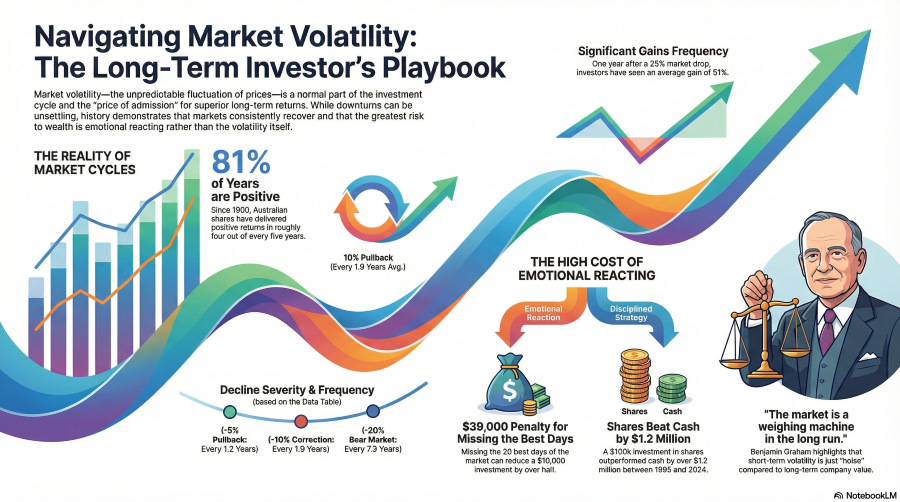
Market volatility is an investment term used to describe when a market experiences a period of unpredictable and sharp price fluctuations. People often think about volatility only when prices fall.
However, volatility can refer to sudden price rises, too. For this Insight, we will focus on volatility in terms of share market downturns, as this tends to worry investors the most.
While company and sector-specific performance can cause volatility in the share prices of individual companies, short-term volatility experienced across the broader market is typically driven by sentiment surrounding macroeconomic and geopolitical factors. In the current environment, there are several of these factors at play that are combining to unnerve and cause volatility in markets — stubborn inflation, expectations of higher-for-longer interest rates, slowing economic growth, the ongoing war in Ukraine, a weaker-than-expected Chinese recovery, and more recently, conflict in the Middle East.
Yes, market volatility is unsettling. Nobody likes seeing negative returns or the value of their investments fall, even if history tells us those falls are only temporary. However, it is essential to understand market volatility is a normal part of investing. Eliminating market volatility is not possible without removing risk, and risk is the price investors pay for higher returns over the long-term.
A better approach is to accept and prepare for periods of market volatility. By being prepared, investors are far less likely to be alarmed and make poor decisions when markets become volatile. Instead of worrying about market volatility, a much better use of time is to focus on their long-term investment strategy, goals and objectives. In this Insight, we cover some key concepts to help investors better navigate market volatility.
Download the full pdf below
 Evidentia_Navigating_Market_Volatility_2026.pdf (4MB) Evidentia_Navigating_Market_Volatility_2026.pdf (4MB) |